Case study / AI automation
Retail AI: making WhatsApp sales conversations useful from the first reply.
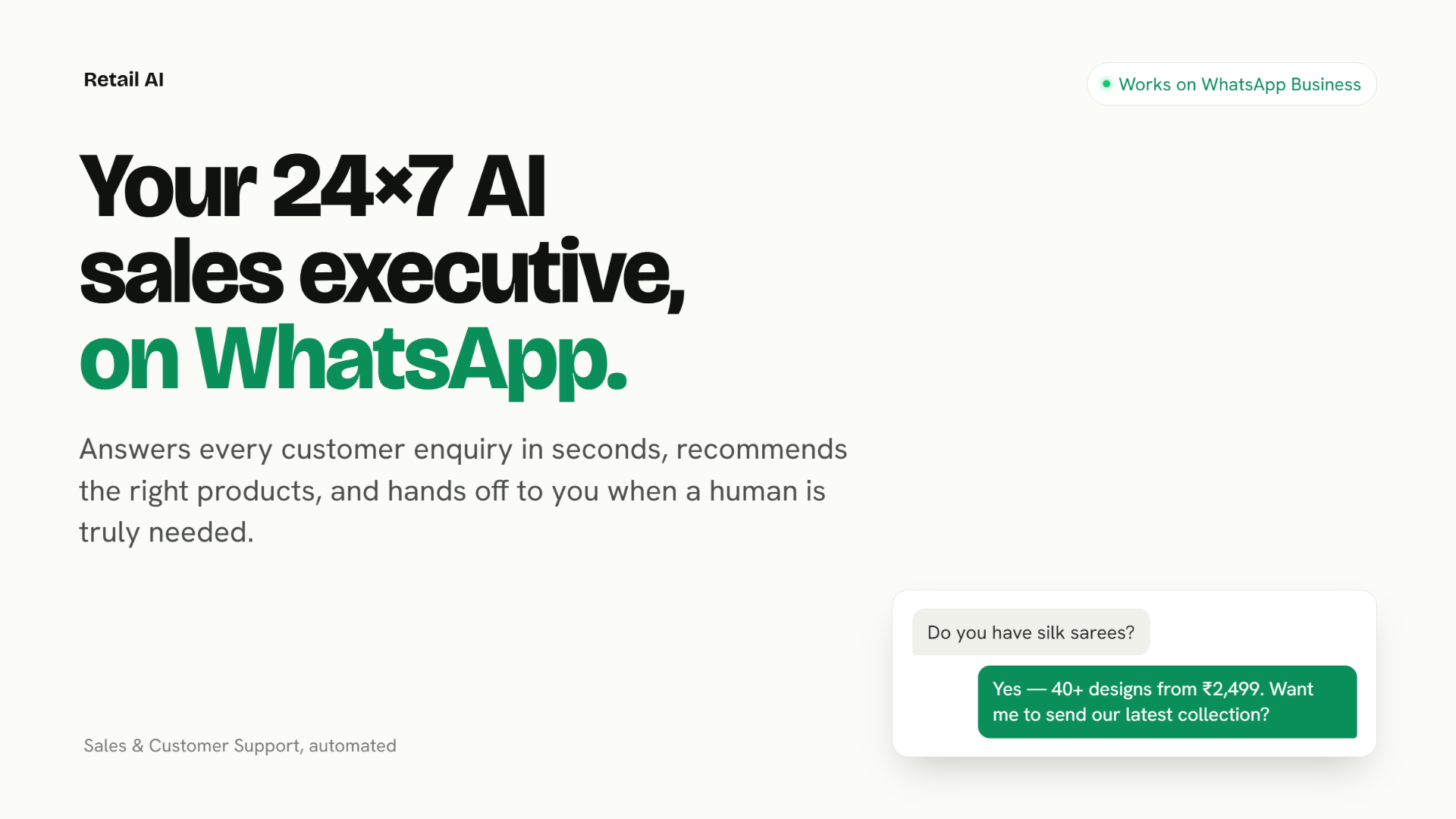
A retail sales assistant designed to answer common questions quickly, recommend the right next step and bring a person in when judgment is needed.
- Project
- Retail AI
- Focus
- WhatsApp sales workflow
- Role
- AI engineering & product build
The problem
Retail customers often begin with short, high-intent questions: whether an item is available, what it costs, which option fits their needs, or whether they can buy today. A slow or context-free response can make that first moment feel harder than it needs to be.
The aim was to create an always-available first layer that could keep a useful conversation moving without pretending it could resolve every exception.
What we designed for
The experience begins with a narrow set of jobs: answer approved product questions, recommend an appropriate option, collect the details needed for a follow-up and hand the conversation to the right person. This gives the automation a clear boundary and gives the sales team a cleaner starting point.
- Short, plain-language replies suited to WhatsApp.
- Recommendations based on the information a customer actually provides.
- A defined source of truth for product, price and policy answers.
- Explicit human handoff for unusual, sensitive or uncertain requests.
The workflow
The useful unit is not a chatbot prompt; it is the whole handoff. A message enters WhatsApp, the assistant identifies the customer’s intent, asks only the next helpful question and records the relevant context. When the request falls outside the approved knowledge or needs discretion, the workflow flags it for a person rather than guessing.
That approach makes response speed valuable without trading away trust. The automation handles the repeatable early work, while people retain ownership of negotiation, exceptions and relationships.
What shipped
The resulting concept is a 24/7 WhatsApp sales assistant for retail enquiries. It is designed to respond in seconds, recommend products and surface a complete lead context for human follow-up. The work connects product thinking—the conversation itself—with the workflow required to make that conversation operationally useful.
Reliability by design
The system is intentionally narrow: approved knowledge for factual answers, explicit escalation when confidence is low, and a complete handoff record for the person taking over. That makes the automation useful under normal conditions and predictable when a conversation moves beyond them.
- Approved information instead of model-generated commercial policy.
- Human ownership of complaints, negotiation and unusual requests.
- Conversation context preserved through every handoff.
- Reviewable transcripts that expose knowledge and routing gaps.
“The goal was not to automate every message. It was to make the first exchange clear enough that a customer feels helped and a salesperson knows what to do next.”Ayush Gupta — project approach
What this approach is useful for
This pattern fits businesses that already receive a meaningful volume of repeat product or booking questions on WhatsApp. It is especially useful where a quick first reply matters, but a human still needs to own exceptions and close higher-consideration sales.
Questions this case study answers
Can a WhatsApp AI agent replace a sales team?
Not reliably. It can handle repeatable early questions and capture context, while people should retain ownership of exceptions, sensitive issues and commercial judgment.
What should trigger a human handoff?
Requests outside the approved information, complaints, urgency, unusual pricing or any situation where the assistant is uncertain should be routed to a person.
Need a reliable AI workflow?
I can engineer the conversation, safeguards, handoffs and automation around the way your team already works.
Book a call ↗